A note: I’ve been meaning to write about this installation at Museum London, that I am fortunate to have been a part of, for months but have always found it extremely difficult to do so. This week marks the painful start of the trial of the individual who committed a sickening act of violence and terrorism against #OurLondonFamily. And so, I’m finally sharing.
On June 6th, 2021, five members of the Afzaal family were out for their evening walk. Salman, his mother Talat, his wife Madiha and their two children, one of whom was Yumnah, aged 15. They were well known and well loved members of the London Muslim and larger community, and that night a stranger fueled by hate and Islamophobia ran them down and murdered four of them. The only survivor was the then 9 year old son, who was seriously injured but pulled through. Since that day he has never been able to see or hug his parents, sister and grandmother again because they were murdered for their faith.
Islamophobia isn’t new. By any means. And yes, it got exponentially worse after 9/11 but Orientalism and the othering of Muslims and Islam has been around for centuries. Now though, it is much more pronounced (and it is increasing) – whether it’s systemic discrimination such as Bill 21 in Quebec, the comments and online hate that are increasingly more widespread, or the acts of extreme violence and terrorism: The Quebec mosque attack in 2017, other violent attacks, including a murder, at mosques in Ontario and across Canada (and the world), the targeting of Muslim women, particularly Somali women in Alberta in recent years and here, in London, the horrific attack on an innocent family who was out for a routine walk.
Any attack, on any group, anywhere in the world is always hard to comprehend. But when it happens in your own city, to a family who is known and loved, less than five minutes away, the pain is much deeper. We were afraid to leave home. I would put on my hijab with pride, but also fear and wonder if it would be the reason I could be taken from this world at any second. I’ve experienced discrimination throughout my life. I’ve been yelled at, sworn at, threatened, had a professor call my hijab a tea towel and tell me I wasn’t “normal” and countless other incidents and microaggressions. It’s the experience of thousands of other Muslims, particularly visibly Muslim women across Canada and worldwide.
But in recent years, it’s become harder. There was a PEGIDA rally here in London mere months after the Quebec attack. I went and tried to be brave while staring white supremicists and Islamophobes in the face, all while holding a sign that said “I belong here. Hate doesn’t” (which is also the message I chose to write on my hexagon) because honestly, I’ve accepted that I, and others who look like me and practice my faith, are the ‘Other’ in the eyes of many and unfortunately that makes us a target for hate.
Being a part of this project and the opportunity to work with YCCI is an incredible honour. For several years my graduate work and thesis and then my career focused on diversity and anti-racism. But art has always been my favourite, and I believe one of of the most powerful means of addressing and challenging racial and cultural stereotypes, discrimination and ignorance. So throughout university and up until today, I have used my art to address the hijab on a personal and political level, as well as my religious and cultural identities and what it means to be Canadian. Even my focus on surface pattern design and decorative and nature inspired art is still heavily influenced by Pakistani handicrafts and painted trucks as well as Islamic geometric patterns.
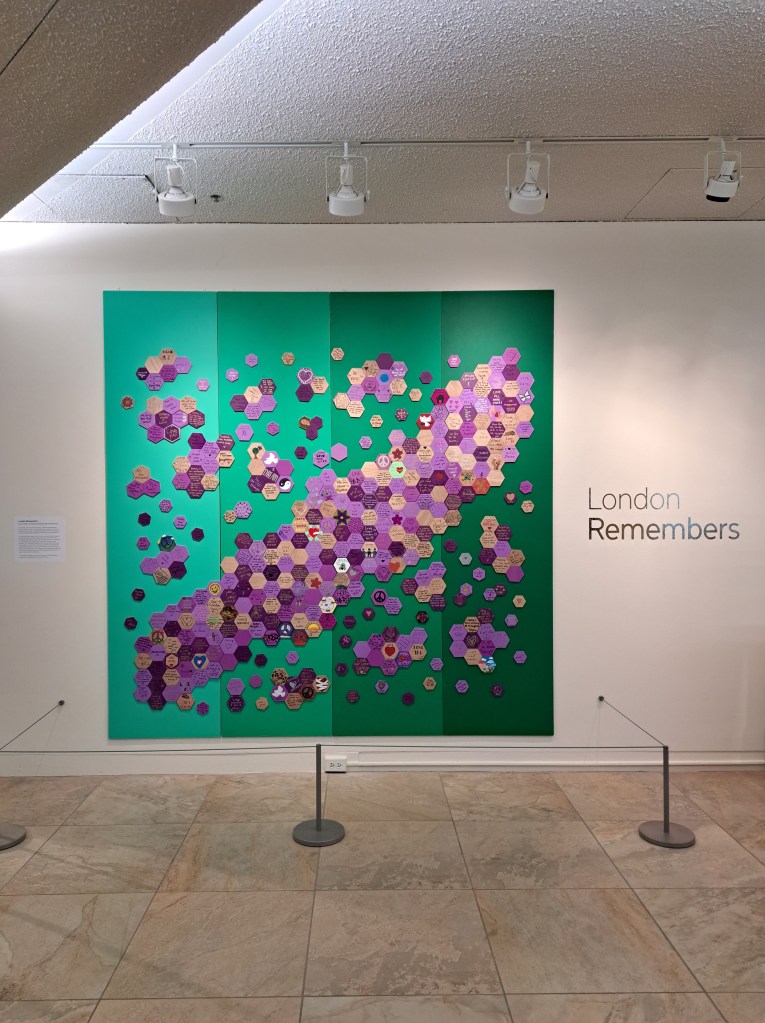
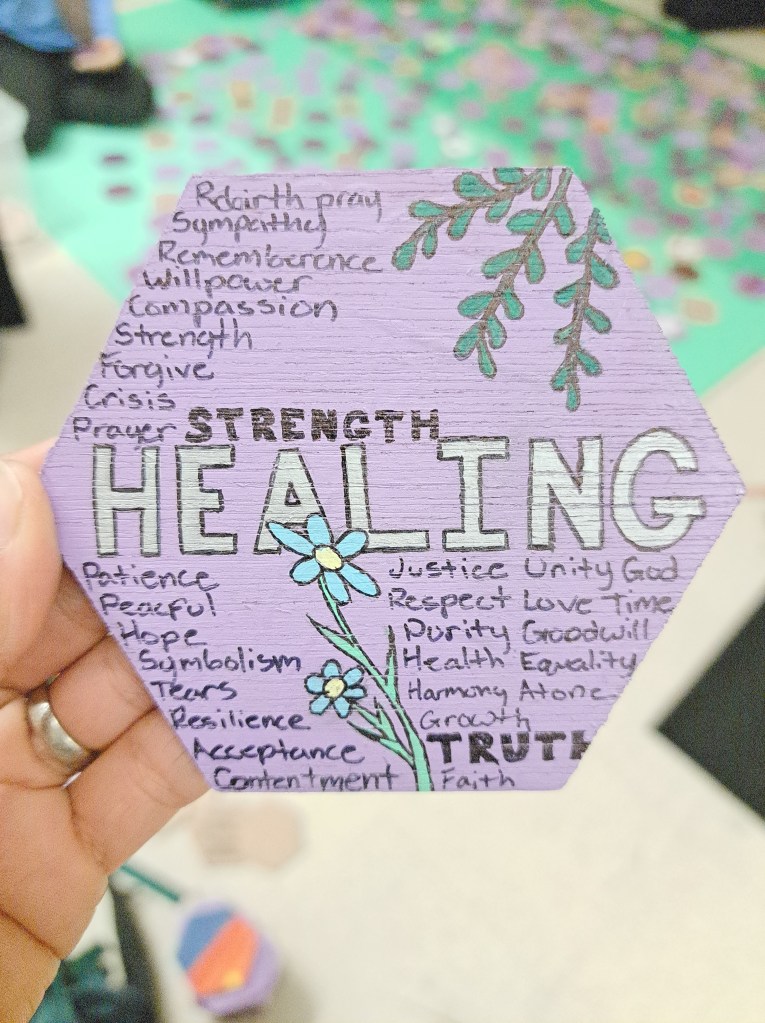
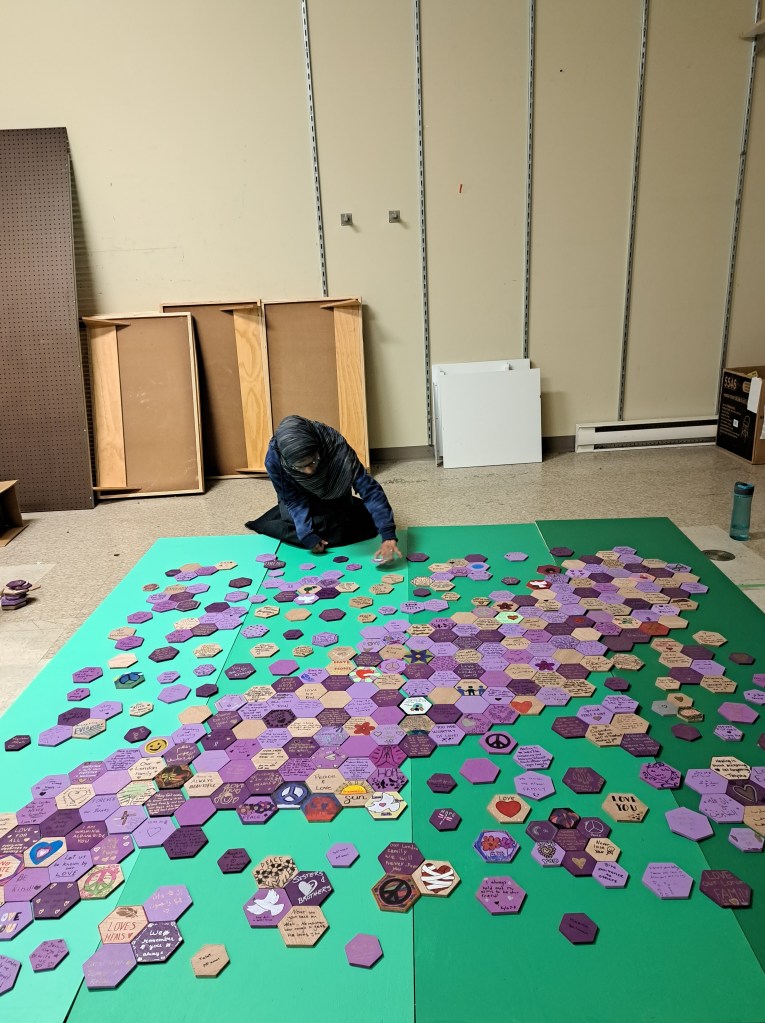
The Youth Coalition for Combatting Islamophobia (YCCI) reached out to me earlier this year asking if I could collaborate with them on their hexagon project and I was thrilled and honoured. The group includes many of Yumnah’s beloved friends and family and I have been hoping for an opportunity to work with them, when and if they were willing, since they formed. They had thousands of wooden hexagons, many painted different shades of purple and members of the London community were given the opportunity write messages on them. Messages of hope, grief, remembrance, defiance, strength, faith, resilience and kindness. Hundreds of students, including many art students I regularly supply teach, created beautiful pieces like the one pictured below. We had submissions from Londonders of all ages and backgrounds. We could only include a select number of the hexagons that were completed in the final installation but I hope that this is a project we can continue on in some form. We then bought the wood to mount the hexagons on, painstakingly selected four shades of green paint (thanks for your patience Selma!) and I led the group in designing, arranging and putting together the final piece. It was 100% a team effort and I am so impressed and inspired by the youth and their adult leaders/mentors. They’ve been through unimaginable trauma, pain and grief and they’ve chanelled that into action.
Art is an incredible tool for change and I pray that this installation can help make this city, and this world even a little bit safer for all of us.
 Art by Aruba